


Common Signs of Dyscalulia
People with dyscalculia all experience difficulty with numbers, but those difficulties don’t always look the same over time. There are important signs at different ages that can help us better understand and identify dyscalculia. As students grow older, they often develop ways to compensate or mask their struggles, even though the underlying challenges remain. Recognizing how dyscalculia can present at different stages helps us provide the right support at the right time.
Young Children/Primary
Difficulty recognizing numbers or connecting numbers to quantities (e.g., knowing that “5” means five objects)
Trouble counting accurately, skipping numbers, or counting the same object twice
Difficulty learning basic number facts (addition/subtraction) despite practice
Confusion about more vs. less, bigger vs. smaller
Struggles to understand number lines or simple patterns
Strong reliance on fingers or physical objects well beyond peers
Upper Elementary Grades
Uses fingers for simple calcPersistent difficulty memorizing math facts (times tables, basic operations)
Trouble understanding place value (e.g., tens vs. hundreds)
Difficulty with multi-step problems, even when language comprehension is strong
Confusion with fractions, decimals, and proportions
Weak sense of estimation or whether an answer makes sense.
Secondary Students
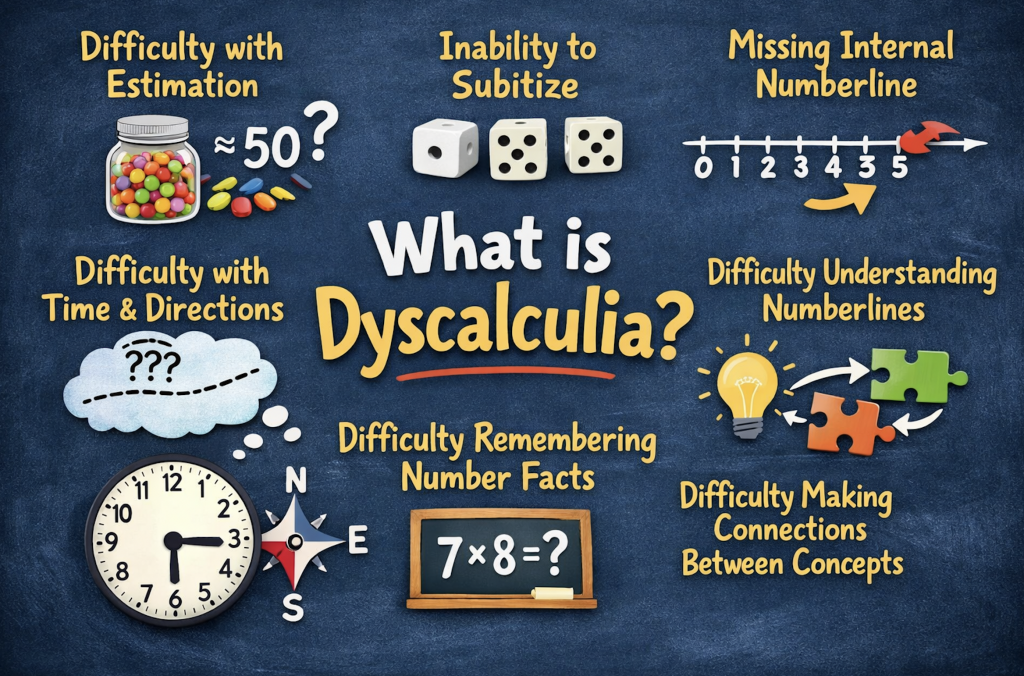
Difficulty with Estimation and knowing whether an answer makes sense
Poor Number Sense
Lack of Flexibility and Use of Inefficient Strategies
Reliance on Calculators or Charts for Basic Calculations
Difficulty with Sequencing and Order of Operations
Difficulty with Time and Directions
Adults
Difficulty with mental math or estimating time, distance, or money
Trouble managing finances, budgeting, or making change
Confusion reading charts, graphs, or schedules
Difficulty remembering numerical information (PINs, dates, measurements)
Reliance on calculators or written notes for even simple calculations
Ongoing feelings of shame, anxiety, or avoidance related to math tasks
General Information

Books
Books for parents, teachers, psychologists, adults with dyscalculia

Courses
Courses for prospective tutors and for educators

Conferences and Events
Conferences for parents, educators and other professionals

Organizations
Organizations that support students and adults with Dyscalculia

OUR MISSION
At The Dyscalculia and Numeracy Alliance (DANA), our mission is to raise awareness about dyscalculia and math learning challenges associated with other SpLD profiles, and to equip individuals—students and adults with dyscalculia, parents, and educators—with the knowledge, tools, and support needed to navigate and thrive with mathematical learning differences. We are also committed to connecting members to specialized service providers who can offer expert guidance and assistance.
Through collaboration, education, and advocacy, we strive to create a world where individuals with dyscalculia have the confidence, skills, and support to thrive in school, work, and daily life.
About Us
The Dyscalculia Association of North America is a collaborative group of parents, physicians, educators, researchers, teacher trainers, and learning specialists who share a deep commitment to improving understanding and support for people with dyscalculia.
We come to this work from different professional and personal paths, but we are united by a common concern: dyscalculia remains widely misunderstood, under-identified, and under-supported. Too many children, adolescents, and adults struggle with mathematics without knowing why—or without access to appropriate help.
Our goal is to change that.
By bringing together lived experience, clinical insight, educational expertise, and research perspectives, we hope to foster greater awareness, earlier identification, and more compassionate, effective support for those affected by dyscalculia across North America.





Advocacy and Awareness
Promoting awareness and understanding of dyscalculia in schools, workplaces, and communities to reduce stigma and ensure equitable opportunities.

Education and Support
Equipping teachers with effective strategies and instructional resources, providing parents with resources, and guiding K-12 and university students toward success in learning and everyday life.

Adult Empowerment
Offering practical tools and accommodations for adults managing dyscalculia in professional and personal settings.

Research and Innovation
Supporting advancements in dyscalculia research and advocating for inclusive policies that foster learning and accessibility.
What Can You Do?
People with dyscalculia all experience difficulty with numbers, but those difficulties don’t always look the same over time. There are important signs at different ages that can help us better understand and identify dyscalculia. As students grow older, they often develop ways to compensate or mask their struggles, even though the underlying challenges remain. Recognizing how dyscalculia can present at different stages helps us provide the right support at the right time.

Very Young and Primary
Business Management
Difficulty learning to count or skipping numbers when counting
Trouble recognizing small quantities without counting (subitizing)
Weak understanding that numbers represent quantities
Difficulty comparing numbers (which is bigger or smaller)
Reliance on fingers or concrete supports longer than peers
Trouble learning number symbols and matching them to quantities
Difficulty remembering basic number facts, even with practice
Confusion with simple addition and subtraction


Secondary School
Business Management
Lorem Ipsum is simply dummy text of the printing


Adults
Business Management
Lorem Ipsum is simply dummy text of the printing